Looking Back - What Has Changed in Rigging Compared to 20 Years Ago
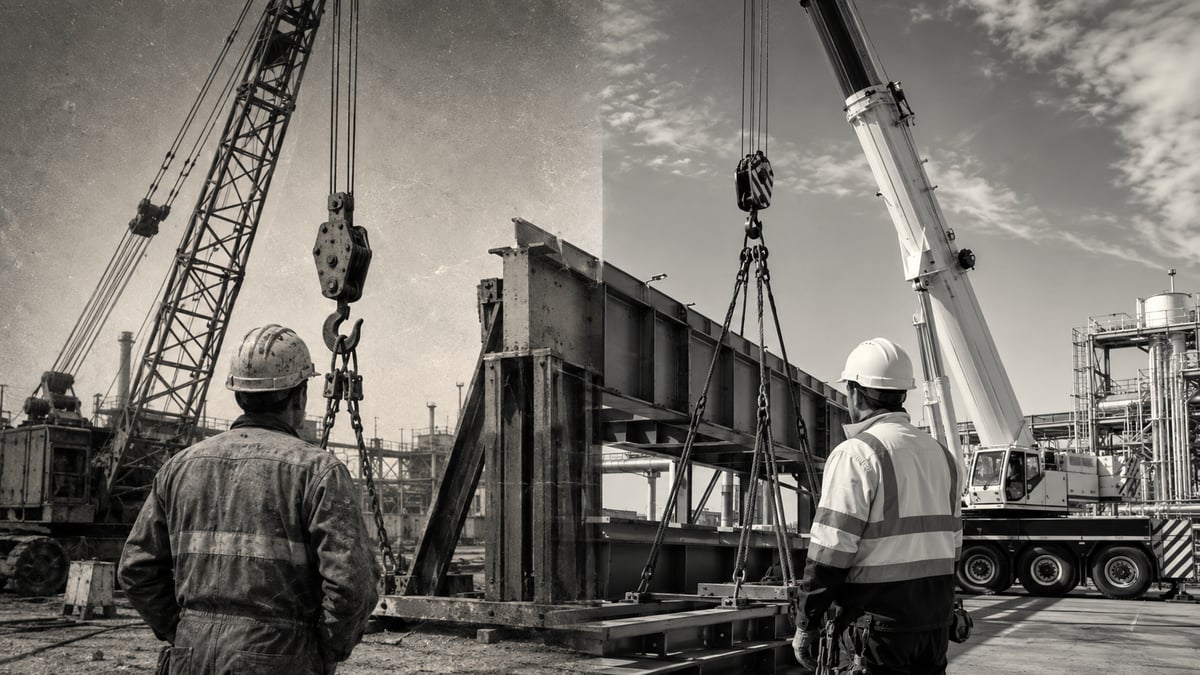
Twenty years is a long time in any trade, but in rigging the shift has been significant. The fundamentals — load, angle, gravity, and respect for what a wire rope can and cannot do — have not changed. Physics does not negotiate. What has changed is how we plan, document, verify, and execute lifts, and the standard the industry now expects before a load leaves the ground.
Lift planning went from a sketch to a document
Two decades ago on plenty of WA sites, a lift was planned on the back of a smoko-room notepad or worked out in someone's head. If the crew was experienced, it often worked. But 'often' is not a safety standard. Today, a documented lift study is the baseline for anything beyond routine work. Critical lifts, tandem lifts, and anything near live plant now demand a written plan with rigging schematics, load charts, ground bearing calculations, exclusion zones, and a nominated lift supervisor.
This is not paperwork for its own sake. A proper lift plan forces you to identify the failure points before you are standing under the load. On shutdown work in the Pilbara and refinery jobs down south, that discipline is what separates a controlled operation from an incident report.
Cranes and load monitoring caught up to the work
The cranes themselves have transformed. Rated capacity limiters, load moment indicators, and real-time monitoring are now standard rather than premium features. Twenty years ago, an operator relied heavily on feel and experience to sense an overload. Now the machine tells you, and it will cut function before it lets you get into trouble.
Telescopic and all-terrain cranes have improved reach and pick-and-carry capacity, which has changed how we approach tight, congested sites. On WA infrastructure and structural steel jobs, that flexibility means fewer crane relocations and tighter lift sequencing.
Rigging gear got smarter and better rated
- Synthetic round slings and high-performance webbing have replaced a lot of wire in general lifting, cutting weight and improving handling without giving up capacity.
- Every sling, shackle, and lifting point now carries clear rating and traceability. Colour-coded tagging and inspection registers are enforced, not optional.
- Load cells and wireless load monitoring have moved from specialist tools to everyday gear on complex picks.
- Engineered lifting lugs and certified attachment points are now expected on fabricated items, rather than someone welding on a padeye by eye.
Competency and licensing tightened up
The biggest cultural shift is around competency. Basic, intermediate, and advanced rigging tickets now mean something specific and verifiable. Verification of Competency assessments are routine before you start on most major WA sites, and principal contractors will check them. Twenty years ago you could talk your way onto a lift. Today you demonstrate it, and the site holds the evidence.
This has lifted the standard across the board. It has also put pressure on genuine experience, because a ticket confirms you can perform a task but it does not replace years of reading loads, ground conditions, and weather. The best crews still combine both.
Safety culture stopped being a poster
Safety has moved from a signed induction and a hard hat to a genuine operating culture. Exclusion zones are enforced. Stop-work authority is real and used. Taglines, dogging communication protocols, and pre-lift checks are non-negotiable. On WA sites, wind monitoring has become a formal part of the decision to lift, not a gut call, particularly with large tilt panels and structural steel where surface area turns a breeze into a serious force.
What has not changed
For all the technology and process, the core still comes down to disciplined people. A load moment indicator does not rig the load. A lift plan does not read the ground when the boom pads start to sink. Experience, communication, and the confidence to call a stop when something is not right remain the difference between a good lift and a bad day.
Where it leaves us
The trade is safer, more accountable, and more capable than it was twenty years ago. The gear is better, the machines are smarter, and the standards are higher. But rigging is still a judgement trade at its heart. The technology supports the decision. It does not make it. That is worth remembering every time a load comes off the ground.
Free quote
GET YOUR LIFTING
PROJECT QUOTE IN MINUTES.
